Elastic energy return
The blade returns part of the energy stored during ground contact.

Application & Value
Use elastic deformation to support movement.
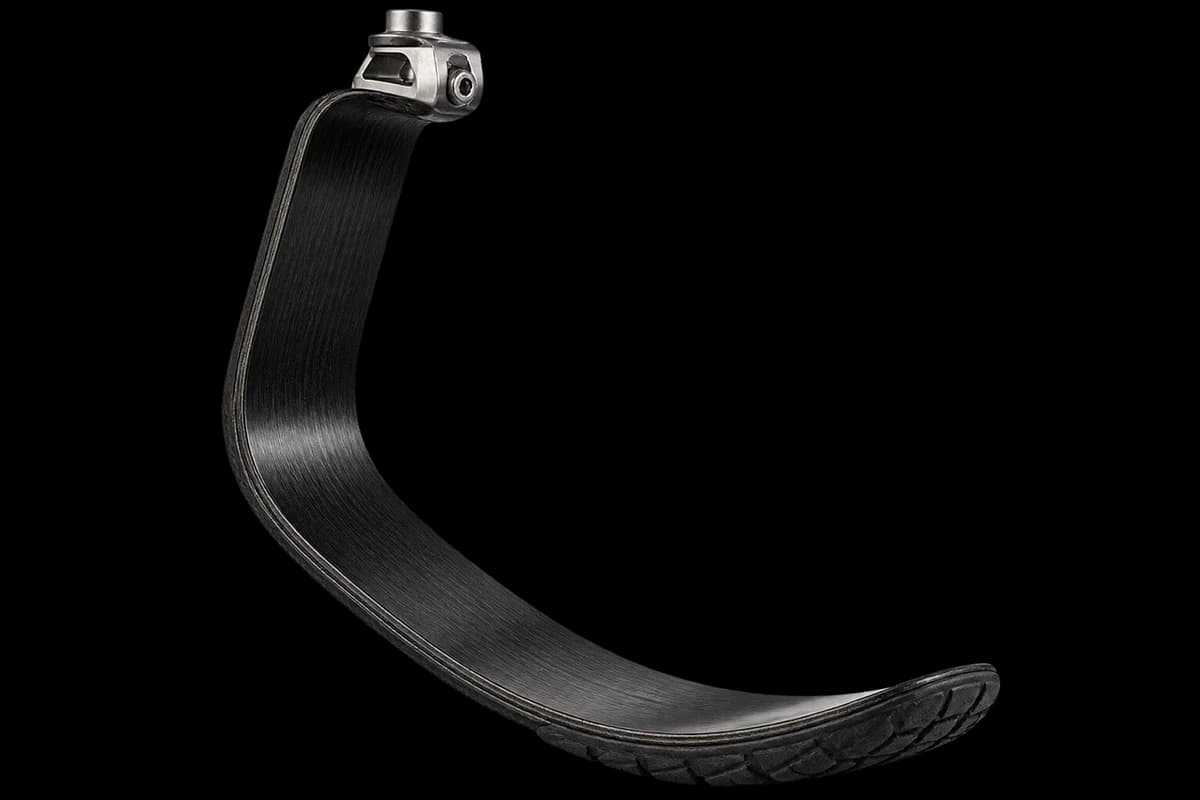
A sports prosthesis must withstand repeated running loads and suit the user’s movement. Body weight, running style and intended activity influence the required spring response. Moving mass should also remain low.
A curved carbon running blade deforms under load and stores elastic energy. It returns part of that energy as the load is released. Shape and structure are tailored to the intended movement response. Individual fitting takes place in the context of the complete prosthesis.
The blade returns part of the energy stored during ground contact.
Different geometries and stiffness levels support adaptation to the activity and user.
A lightweight blade limits the additional mass moved with the prosthesis.
Elastic deformation can be a useful product property. For movement-related products, load absorption, energy return and user interaction therefore need to be considered together. This approach also applies to other spring components whose response must remain suitable over many loading cycles.
CoDe structures your challenge and clarifies relevant solution directions. CoDe Matching connects your enquiry with suitable capabilities and companies. You gain a sound basis for your decision.